|
VERTRIEB: SPV
WEBSITE: www.xavierrudd.com
 |  |
For so many artists, the divide between their live shows and their albums can be enormous. And for an artist like Xavier Rudd, who utterly thrives in front of audience, and feeds off its energy, capturing that live electricity has always proved a wee elusive—that is, until now.
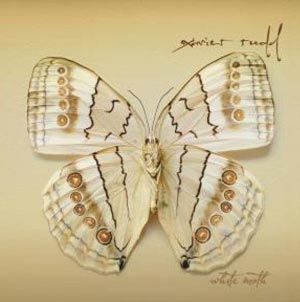
With White Moth he’s finally harnessed that spirit, thus realizing a goal of combining the acoustic warmth offered by a studio with the adrenalin of the stage. Yet the disc, the Australian roots music star’s fourth album (and third to be released in the U.S.), isn’t all about sound techniques, fidelity and the stuff that keep soundman chatting into the middle of the night.
Rather, it’s just the opposite, as White Moth charts the spiritual journey multi-instrumentalist Rudd has been on over the past few years, during which he’s traveled the globe and built a devoted following drawn to his amalgamation of folk, reggae, rock and world music. Featuring guest vocals from Aboriginal singers, it finds him paying respect to Australia’s indigenous people, from whom the didgeridoo virtuoso has drawn bottomless inspiration.
Lyrically, it pays homage to those same people, and also to his wife and children, environmental activists—whom he refers to as the “better people”—and to the people who make this life possible, his fans, who fuel the spirit of White Moth.
Co-produced by Rudd and Dave Ogilvie (David Bowie, Marilyn Manson and N.E.R.D.), most of the album’s tracks were captured in the woods of British Columbia’s Sunshine Coast at Gggarth Richardson’s studio, The Farm. It was there that Rudd, in order to capture the bigness of his live sound, plugged into a P.A. system, which was then mic-ed. Rudd set up various instruments, like his didgeridoos and stomp boxes, in other rooms, from which he and Ogilvie could capture woody tones that could be fused to the electric tracks.
“On quite a few of songs, it sounds like there’s bass, but that’s just me playing live,” says Rudd. “I have a technique that I figured out, where I’m playing basslines off my thumb while I play the melody with my fingers—finger picking. It sounds like a bass player playing, but it’s just me. So it’s great, I’m especially stoked with how we captured that.”
Within the songs composing White Moth, Rudd takes you on a personal tour of his world. The title track and the song “Stargaze” come from time spent with his wife and their two children. The former remembers a night they spent sleeping under the stars, while “White Moth” recalls a particularly special moment on the day of his wife’s 30th birthday, when the family was vacationing on an island off the coast of Sri Lanka: “That day, a white moth came to our six-year-old, a beautiful white moth and stayed with him for about three hours. We thought it was the spirit of my wife’s grandmother, which is often with her. It sort of reflects that day, which was a really positive day, and my wife, who has been the backbone of this whole career of mine for years.
“This album,” Rudd notes, “feels like an amazing recording. It’s been a really good space and a really good time, and it’s just sort of a nice, positive reflection of our whole journey over the last seven or eight years.”
Featuring appearances by members of the esteemed Aboriginal musical group Yothu Yindi, percussionist Dave Tolley, Panos Grames, and First Nations Cree elder Kennitch, White Moth is representative of Rudd’s entire life, ranging from those snapshots of life at home on Australia’s south coast (in the town of Jan Juc), and meditations on friends (“Twist”) and the family bond (the cancer victim in “Choices”) to emotional and literal trips to Australia’s historic Arnhem Land, an Aboriginal territory whose people are the subject of the song “Land Rights.” Rudd recorded some of the guest vocals on White Moth here, and with an elder in Canada, where his wife was born.
“These people are the special people, who, as human beings, have been connecting with this land for thousands and thousands of years in their family lives,” says Rudd. “I feel like these people have been denied a voice in the white settlements in Australia. We live in a time where we’re rapidly deteriorating the environment—in a manner of a couple hundred years. They’ve been on the planet for 60,000 years without leaving a stone unturned environmentally. So I feel like these people should be given a voice.”
With the music building into a storm-like squall at song’s end, “Footprint” examines the damage being done by global warming, while “Better People” is Rudd’s tribute to the people who deserve more credit for their environmental activism than he: “I feel kind of guilty sometimes because I’m getting highlighted for those things, while, in my busy life, I’m constantly touring, constantly playing through these power-hungry P.A. systems in a time when global warming is so critical, so I feel a little toxic in the existence that I live in. So that song is like a respect song to the people who should be doing those interviews, the ones who are strapping themselves to trees, out in the ocean saving whales and feeding kids in Africa. They’re the real heroes.”
A one-man-band/multi-instrumentalist who plays guitars, shakers, didgeridoos, Weissenborn slide guitars, stomp boxes, djembes, harmonica, ankle bells, and slide banjo, Rudd made his U.S. debut in 2004 with Solace. In the three years since, his popularity and reputation have begun to mushroom for a string of conscious, heartfelt songs and, maybe more so, for a rather impressive stage show that often finds him performing those songs’ guitar, didgeridoo and various percussion parts simultaneously—using a unique set-up that finds him literally surrounded by his various instruments and singing from behind a stand holding three didgeridoos (of different keys).
A bona fide star in Australia, Rudd grew up in Bell’s Beach in Southern Victoria, notable for its cameo in the memorable surf film Point Break. Reared in a music-friendly environment, where his parents spun records by the likes of Neil Young and Paul Simon, as a child Rudd played guitar, clarinet, saxophone and didgeridoo, the 50,000-year-old wooden trumpet of the Aborigines.
In 2002, Rudd released his debut album in Australia, To Let, which was followed by Solace and in 2004 by Food in the Belly, his debut for Anti-, for which he has trekked across the U.S. several times supporting—amassing a burgeoning grass-roots fanbase and the admiration of the likes of Ani DiFranco and Jack Johnson, while hitting many of the country’s top festivals, like Bonnaroo.
Both Solace and Food in the Belly have been certified platinum and gold sales certifications in Australia, while his 2006 DVD Good Spirit (2006)—filed at a sold-out 2004 show in Sydney—was also recently certified gold in Australia.
Of White Moth, he says, “I think the record is just a reflection of my journey and my journey is amazing. It’s a reflection of a connection with powerful people around the world—powerful spirits—but also connections with the energy that people bring to my show. You know, I’m really lucky that I have such a good and amazing support base everywhere I go. Great people come to my gigs, and they bring beautiful energy, and that energy flows through me everywhere I go, every show I play.
“It all shapes what I do. So I feel like everyone that’s been part of this journey to me, down to everyone who comes to the gig has helped shape what this album has become. And it’s a really positive one for me. It’s the most positive recording I’ve done, in terms of sitting back and saying, ‘Wow, what a journey, here it is, I hope it reflects it.’”
(Quelle: Anti Records)
FORMAT: CD
|